Is Dubai Property Still a Good Investment in 2026?
A Data-Driven Analysis of the Opportunities, Risks and Strategies International Investors Need to Understand
A Data-Driven Analysis of the Opportunities, Risks and Strategies International Investors Need to Understand
Last updated: July 2026
Dubai property has delivered exceptional growth since the market recovery began in 2020. Prices have risen, rental demand has strengthened, new developments have launched at remarkable speed, and international capital has continued flowing into the city. That success has created a new question.
Is Dubai property still a good investment in 2026, or have investors already missed the best opportunity?
The honest answer is that Dubai remains one of the world's most compelling real estate markets, but the strategy that worked several years ago will not necessarily produce the same results today.
In the early stages of a market recovery, buyers can sometimes benefit simply by entering at the right time. In a more mature phase, selection becomes far more important. The difference between a strong investment and an average one now depends on the community, developer, entry price, property type, payment structure, service charges, future supply and exit strategy.
Dubai is not a market where every property automatically generates a high return. It is a market where carefully selected properties can still perform exceptionally well.
This guide examines the Dubai property market without relying on sales slogans or exaggerated promises. It explains what is supporting demand in 2026, where the risks are increasing, how international economic conditions affect Dubai, and how experienced investors separate a genuine opportunity from an attractive brochure.
The 2026 Answer in One Paragraph
Dubai property can still be a good investment in 2026 for buyers who have a clear objective, a realistic holding period and the discipline to analyse individual assets rather than buying the market blindly.
The underlying case remains strong:
-
Dubai's population continues to expand.
-
International businesses and professionals continue relocating to the UAE.
-
The economy is diversified across tourism, aviation, finance, logistics, technology, trade and professional services.
-
Foreign buyers can own property in designated freehold areas.
-
The tax treatment remains attractive for many private investors.
-
Rental demand is supported by a large expatriate population.
-
Infrastructure and new master developments continue reshaping the city.
-
Dubai remains internationally connected and comparatively easy to access.
At the same time, investors must consider rising supply, high service charges in certain buildings, differences in developer quality, construction risk, changing interest rates and the possibility of slower price growth after several exceptional years.
The opportunity has not disappeared. The easy phase of the opportunity may have.
Dubai Property Market Snapshot for 2026
The first quarter of 2026 demonstrated that Dubai's real estate market was still operating at substantial scale.
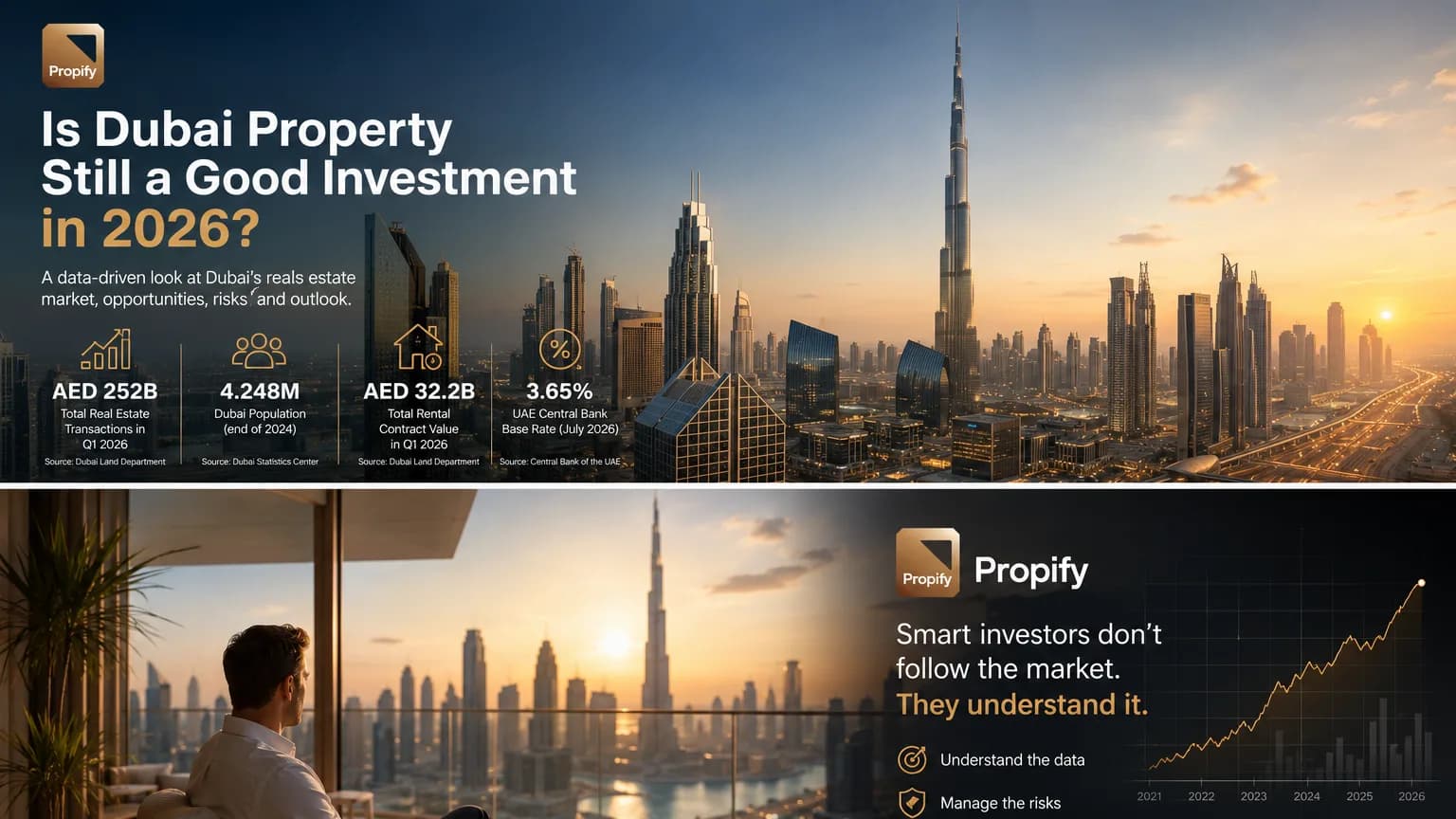
According to the Dubai Land Department, the total value of real estate transactions reached approximately AED 252 billion in Q1 2026, representing a 31% year-on-year increase in value. The quarter included more than 60,000 real estate transactions, while the value of investments reached approximately AED 173 billion across 57,744 investments.
Dubai's rental market also remained active. The Dubai Land Department reported that rental contracts recorded during Q1 2026 had a combined value of approximately AED 32.2 billion. This included 118,385 new contracts and 135,607 renewals.
These figures do not prove that every property is undervalued. They do show that demand, liquidity and investor participation remain considerable.
Dubai is no longer a small emerging property market dependent on a narrow group of speculative buyers. It has developed into a large and internationally diversified market with off-plan sales, secondary transactions, mortgages, institutional participation, end users, landlords and investors operating across many price segments.
2026 market signals at a glance
| Indicator | Current signal | What it means for investors |
|---|---|---|
| Q1 2026 total transaction value | AED 252 billion | Market activity remains high |
| Q1 2026 investment value | AED 173 billion | Capital continues entering the sector |
| Q1 2026 rental contract value | AED 32.2 billion | Rental demand remains substantial |
| Dubai population at end of 2024 | 4.248 million | A growing resident base supports housing demand |
| UAE Central Bank base rate in July 2026 | 3.65% | Financing is still a meaningful cost |
| UAE 2026 real GDP growth forecast | Positive, though forecasts vary | Economic expansion continues, but uncertainty remains |
Dubai's official population bulletin estimated the emirate's population at approximately 4.248 million at the end of 2024. Population growth matters because property demand ultimately depends on people needing somewhere to live, not merely on investors exchanging units with each other.
The UAE Central Bank listed its base rate at 3.65% in July 2026. Mortgage affordability therefore remains an important consideration, especially for investors using high leverage or relying on short-term resale rather than rental income.
Have Investors Already Missed the Best Time to Buy?
There is an old proverb:
The best time to plant a tree was 20 years ago. The second-best time is today.
Real estate follows a similar principle, but only when the asset is selected carefully.
It would clearly have been better to purchase prime Dubai property at the beginning of an earlier growth cycle. The same can be said about London several decades ago, central Berlin before prices rose, parts of New York before neighbourhoods transformed, or technology shares before they became globally dominant.
That observation does not help an investor making a decision today. The relevant question is not:
Could I have purchased more cheaply in the past?
The relevant questions are:
-
Is the city's population likely to be larger in ten years?
-
Is the economy likely to generate more employment?
-
Will international businesses continue operating from the city?
-
Will the specific community become more desirable?
-
Is the property scarce enough to retain demand?
-
Is the entry price reasonable compared with comparable properties?
-
Can the investment generate acceptable income while it is held?
-
Is there a realistic future buyer for the asset?
Investors often remain inactive because they are waiting for a perfect moment that is only visible afterwards. The absolute bottom of a market can rarely be identified in real time. It becomes obvious years later, once prices have already recovered. The objective should not be to predict the exact lowest price.
The objective should be to purchase a good asset at a defensible price, hold it for a sensible period and avoid mistakes that permanently damage returns.
Investor Psychology: Why Fear Creates Both Risk and Opportunity
Most people describe themselves as long-term investors when markets are rising. Their behaviour often changes when negative headlines appear.
A similar emotional cycle can be seen in stock markets:
-
Prices rise and optimism increases.
-
Buyers enter because they are afraid of missing out.
-
One or more negative events create uncertainty.
-
Investors sell because they fear further losses.
-
Falling prices create more fear and additional selling.
-
Patient buyers begin acquiring quality assets at better valuations.
-
Confidence eventually returns, often after the strongest opportunities have passed.
This does not mean investors should automatically buy whenever a market falls. A declining asset is not necessarily a bargain. Some prices fall because the underlying investment is poor. The intelligent contrarian investor distinguishes between two situations:
Temporary fear affecting a fundamentally strong asset
and
A genuine deterioration in the asset's long-term value
This distinction applies to Dubai property.
A period of geopolitical uncertainty, weaker sentiment or slower transaction growth may create negotiation opportunities. However, it does not make every development a good investment. An oversupplied location, weak developer, badly designed unit or building with excessive service charges can remain a poor investment even when the wider market recovers.
Smart investors do not buy simply because other people are afraid. They use periods of fear to analyse assets that were previously overpriced or difficult to negotiate.
The Propify perspective
The best opportunities often appear when three conditions meet:
-
The wider market is cautious.
-
The individual asset remains fundamentally strong.
-
The seller or developer offers a meaningful advantage.
That advantage may be a lower entry price, a motivated resale seller, a stronger payment plan, a unit with a superior view, an unusually efficient layout or a property in a community where future supply is limited.
Fear alone is not an investment strategy. Fear combined with research, liquidity and patience can create one.
Why Global Uncertainty Can Strengthen Dubai's Relative Position
Dubai should not be analysed in isolation. International investors compare it with alternatives in Europe, North America, Asia and their home markets.
Capital usually moves towards a combination of safety, opportunity, liquidity, tax efficiency and legal accessibility. Dubai does not need every competing market to fail. It only needs to remain comparatively attractive.
Europe: stability, but increasing pressure on returns
Europe remains one of the world's most developed and institutionally stable regions. It would be inaccurate to describe Europe as one single market or claim that all European capital is leaving.
However, many investors and business owners are dealing with:
-
Slower economic growth
-
High energy and labour costs
-
Increased regulation
-
Higher taxes in certain jurisdictions
-
Housing affordability challenges
-
Lower net rental yields in some major cities
-
Political uncertainty
-
Ageing populations in several countries
-
Complex landlord and tenant regulations
The World Bank expected growth across developing Europe and Central Asia to weaken to approximately 2.1% in 2026, down from 2.6% in 2025. Conditions differ significantly between countries, but the regional outlook illustrates why internationally mobile investors are considering geographic diversification.
A German, French, British or Scandinavian investor does not necessarily need to abandon Europe to invest in Dubai. Dubai can serve as a second market within a diversified portfolio.
An investor may keep a stable European property while acquiring a Dubai asset for stronger income potential, exposure to population growth and access to a different economic region.
Russia, Ukraine and Belarus: relocation driven by geopolitical reality
Since 2022, migration and capital movement from Russia, Ukraine and Belarus have been influenced by war, sanctions, banking restrictions, security concerns and business uncertainty.
Dubai has attracted part of this mobile population because it offers:
-
International flight connections
-
Established Russian-speaking communities
-
Business formation options
-
Modern banking and professional services
-
High-quality residential developments
-
International schools
-
A relatively familiar environment for globally mobile entrepreneurs
This demand should not be interpreted as permanent or guaranteed. Capital flows can change when regulations, exchange rates or geopolitical conditions change. It nevertheless forms part of Dubai's broad international demand base.
China: property weakness encourages diversification
China's property sector has faced a prolonged correction.
Official Chinese statistics showed that real estate development investment declined by 11.2% year-on-year during the first quarter of 2026. Residential development investment declined by 11%, newly started residential floor space fell by 22%, and individual mortgage funding received by developers fell sharply.
This does not mean Chinese investors will automatically purchase in Dubai. China maintains capital controls and investor behaviour is affected by domestic policy.
It does mean that property is no longer viewed as an unquestioned domestic wealth engine in the same way it once was. Investors able to diversify may increasingly compare overseas markets, including the UAE.
United States: a strong market with affordability constraints
The United States remains one of the deepest and most liquid property markets in the world.
However, high purchase prices, financing costs, insurance expenses, property taxes and homeowners' association fees can make entry difficult in major cities.
The US Census Bureau reported that median monthly ownership costs for homeowners with a mortgage increased to $2,035 in 2024, up from an inflation-adjusted $1,960 in 2023. The median sale price of a new house was approximately $398,300 in June 2026. Dubai is not automatically cheaper than the United States. Prime Dubai communities can be extremely expensive.
The difference is that Dubai may offer certain investors:
-
No recurring annual property tax in the conventional Western sense
-
Potentially stronger gross rental yields
-
Newer buildings
-
Lower entry points in selected communities
-
International ownership in designated freehold areas
-
A location connecting Europe, Asia and Africa
Why Dubai Continues Attracting Millionaires and Business Owners
Dubai's appeal to wealthy individuals is not based on property alone. A high-net-worth buyer may consider the entire operating environment:
-
Where the family wants to live
-
Where a company can recruit staff
-
How easily international clients can be reached
-
Whether earnings can be moved and invested efficiently
-
The availability of private schools and healthcare
-
Personal security
-
Airport connectivity
-
Residency options
-
Lifestyle quality
-
The overall tax framework
For entrepreneurs selling software, consulting, e-commerce services or other internationally delivered products, physical distance from the end customer is less important than it was 20 years ago. A business can be headquartered in Dubai while serving customers in Europe, Asia, Africa and North America.
That does not mean relocating automatically eliminates tax obligations elsewhere. Tax residency, company management, permanent establishment rules, controlled foreign company regulations and exit taxes can remain relevant. Business owners should obtain professional cross-border tax advice before relocating. The wider point is that Dubai gives internationally mobile entrepreneurs a credible alternative.
When business owners relocate, they do not only rent offices.
They rent or purchase homes, bring employees, enrol children in schools, use local services and often reinvest part of their wealth in the property market. This creates demand that is linked to economic activity rather than tourism alone.
Dubai's Tax Advantage: Powerful, but Often Oversimplified
The phrase "tax-free Dubai" is widely used and frequently misunderstood.
The UAE does not impose a federal personal income tax on ordinary salaries in the way many European countries do. For natural persons, personal investment income and real estate investment income held in a personal capacity are generally not treated as business activities for UAE corporate tax purposes. That does not mean every investor pays no tax anywhere.
A buyer may still have obligations in:
-
Their country of tax residence
-
Their country of citizenship, in certain cases
-
A country where a company is managed
-
A jurisdiction applying controlled foreign company rules
-
A country applying inheritance, wealth or capital gains taxes
-
A jurisdiction where income must be declared even if the property is abroad
There are also transaction and ownership costs in Dubai, including registration fees, agent commissions, service charges, mortgage costs, maintenance and possible management fees.
The correct claim is not:
Dubai property is completely tax-free.
The correct claim is:
Dubai offers an attractive local tax environment, but the investor's total tax position depends on personal residency, ownership structure and home-country rules.
That is a less exciting slogan, but it is much more useful.
The Strongest Fundamental Driver: Population Growth Property markets need residents. A skyline alone does not create sustainable demand. Dubai's estimated population reached approximately 4.248 million at the end of 2024.
Population growth affects the property market in several ways:
-
New residents require rental accommodation.
-
Families moving permanently may become buyers.
-
Companies require offices and employee housing.
-
Population growth supports retail, hospitality and logistics.
-
Infrastructure investment follows expanding communities.
-
Schools, healthcare facilities and leisure venues improve local desirability.
The most important question is not only how many people move to Dubai. It is what type of residents arrive. A temporary construction worker, a senior executive, a business owner and a family with school-age children create different housing demand. This is why investors must connect the property type with the expected tenant.
A luxury one-bedroom apartment, an affordable studio, a family townhouse and a waterfront villa serve completely different markets.
Investor insight
Do not begin with the development. Begin with the future resident.
Ask:
-
Who will live here?
-
Why will they choose this location?
-
What can they afford?
-
What alternative properties can they rent?
-
How many competing units will exist at handover?
-
Will the tenant remain for one year or several years?
The best rental properties solve a clear housing need.
Dubai's Economic Case Extends Beyond Oil
One of the most persistent misconceptions is that Dubai's property market is directly dependent on oil. Dubai benefits from the wider UAE economy and regional energy wealth, but its own economic model is highly diversified.
Important sectors include:
-
Tourism and hospitality
-
Aviation
-
Trade and logistics
-
Financial services
-
Technology
-
Professional services
-
Construction
-
Retail
-
Healthcare
-
Education
-
Digital businesses
-
Real estate
The IMF's forecasts have varied as global conditions changed, but the organisation has continued to project positive UAE economic growth in 2026. Its country data page currently lists projected real GDP growth of 3.1% for 2026, while an earlier 2025 Article IV mission projected stronger expansion. The difference is a reminder that economic forecasts are estimates rather than guarantees.
For property investors, the key point is that housing demand is connected to multiple industries. A diversified employment base is generally more resilient than dependence on one sector.
Rental Income: Attractive, but Never Accept the Headline Yield Dubai is often promoted as a market where rental yields of 6%, 8% or even 10% are easily achievable.
Some properties can produce these returns. Many will not.
The most common marketing calculation uses gross yield:
Annual rent ÷ purchase price × 100
For example:
-
Purchase price: AED 1,000,000
-
Annual rent: AED 80,000
-
Gross yield: 8%
That figure does not include the real cost of ownership.
A professional investor calculates net yield after considering:
-
Service charges
-
Maintenance
-
Property management
-
Leasing commission
-
Vacancy
-
Furnishing and replacement costs
-
Insurance
-
Mortgage interest
-
Registration expenses
-
Utility or cooling obligations paid by the owner
-
Short-term rental platform and operator fees
-
Expected repairs between tenants
A more realistic example
| Item | Amount |
|---|---|
| Annual rent | AED 80,000 |
| Service charges | -AED 14,000 |
| Management and leasing | -AED 5,600 |
| Maintenance reserve | -AED 3,000 |
| Vacancy allowance | -AED 3,100 |
| Net operating income | AED 54,300 |
The property's gross yield appears to be 8%. Its estimated net operating yield before financing is closer to 5.43%.
Neither calculation is universally correct. The value depends on the actual building, contract, vacancy, management arrangement and maintenance history.
Propify insider tip
Whenever an agent presents a yield, ask for five figures:
-
The most recent signed annual rental contracts in the same building
-
The current service charge per square foot
-
Expected leasing and management fees
-
Historical or realistic vacancy
-
The property's total acquisition cost, not only its advertised price
A yield based on the asking rent of a beautifully furnished listing is not the same as a yield based on signed contracts.
Off-Plan Property: Opportunity and Risk in the Same Contract Off-plan property remains central to Dubai's market.
It can provide:
-
Lower initial cash requirements
-
Staged payment plans
-
Access to new communities
-
Potential appreciation before completion
-
Modern layouts and amenities
-
Promotional incentives
-
The opportunity to choose a superior unit early
It also introduces specific risks:
-
Construction delays
-
Changes in market value before handover
-
Quality differing from marketing material
-
A large number of similar units completing together
-
Difficulty reselling before a contractual payment threshold is reached
-
Higher post-handover service charges than expected
-
Payment obligations continuing during a weaker market
-
Developer-specific transfer restrictions
-
Financing uncertainty at handover
Dubai requires developers selling off-plan units to use project escrow accounts, with buyer payments deposited into designated accounts intended to regulate development and protect investor rights. The Dubai Land Department also provides a project-status enquiry service where buyers can review project details and completion progress.
Escrow regulation reduces certain risks.
It does not guarantee that every project will be delivered exactly on time, achieve its forecast resale value or generate the advertised rent.
What experienced off-plan investors investigate
-
Is the project registered with the Dubai Land Department?
-
Is the payment going into the correct project escrow account?
-
Does the developer have completed comparable projects?
-
How did those earlier projects age after handover?
-
What is the actual construction progress?
-
Is the price premium justified?
-
How many competing units will be delivered nearby?
-
What percentage must be paid before resale is allowed?
-
Is a no-objection certificate required?
-
Are assignment or transfer fees payable?
-
What happens if the buyer misses an instalment?
-
Can the developer change the layout, materials or completion date?
-
What are the expected service charges?
-
What infrastructure will genuinely exist at handover?
Propify insider tip
Do not evaluate an off-plan project only against its own price list.
Compare it with:
-
Ready properties in the same area
-
Recent resale transactions
-
Other off-plan launches nearby
-
The developer's previous completed buildings
-
Expected rent at handover
-
Total competing supply
A discount against the next launch price is not necessarily a market discount.
Developers control their own price lists. The secondary market reveals what independent buyers are actually willing to pay.
Ready Property: Less Exciting, Often More Measurable
Ready property offers advantages that are easy to underestimate:
-
The unit can be inspected.
-
The view is known.
-
The building quality can be assessed.
-
Service charges are available.
-
Existing rent can be verified.
-
Tenant demand can be measured.
-
The surrounding infrastructure already exists.
-
Mortgage valuation is possible.
-
Income may begin immediately.
The disadvantages may include:
-
A larger upfront cash requirement
-
Less flexible payment structures
-
Renovation or furnishing costs
-
Older mechanical systems
-
Existing tenants
-
Lower speculative upside than an early-stage master development
-
Seller pricing based on recent market growth
Ready properties are particularly useful for investors focused on income rather than speculation. They also create negotiation opportunities when sellers are motivated by relocation, refinancing, business liquidity or the need to complete another purchase.
Financing and the Cost of Leverage
Debt can improve equity returns when property values and rental income perform well. It can also amplify losses. The UAE Central Bank's base rate stood at 3.65% in July 2026, and EIBOR remains an important benchmark for mortgage pricing.
The Central Bank requires mortgage providers to apply affordability and stress-testing rules. Borrowers should be assessed against the possibility that interest rates rise above the initial loan rate.
Investors should test the property under several conditions:
-
Current mortgage rate
-
A rate 2 percentage points higher
-
Rent 10% below expectation
-
One month of annual vacancy
-
Service charges 15% above estimate
-
No capital appreciation for three years
-
A resale price 10% below purchase cost
When an investment only works under the most optimistic scenario, it does not work.
Insider tip
Never use every available pound, euro, dollar or dirham for the deposit.
Keep a liquidity reserve for:
-
Instalments
-
Handover costs
-
Furnishing
-
Vacancy
-
Mortgage payments
-
Service charges
-
Repairs
-
Delayed resale
-
Currency fluctuations
Forced sellers rarely achieve the best price. Liquidity gives an investor time, and time is one of the strongest protections in real estate.
The Costs Buyers Commonly Underestimate The purchase price is not the total investment.
For a standard property purchase, buyers should budget for costs that may include:
-
Dubai Land Department registration fee
-
Trustee or registration-centre fee
-
Brokerage commission
-
VAT on brokerage services
-
Mortgage registration fee
-
Bank arrangement fee
-
Property valuation
-
Developer no-objection certificate
-
Conveyancing
-
Furnishing
-
Utility deposits
-
Service charges
-
Property management
-
Maintenance reserve
Dubai property sales commonly involve a 4% registration fee, while a mortgage may also attract a registration fee calculated as a percentage of the mortgage value. Exact responsibility for fees can depend on the transaction and agreement.
A property advertised at AED 1 million does not represent an AED 1 million total acquisition. Investors should calculate return using the complete cash invested.
Service Charges Can Destroy an Apparently Good Investment
Two apartments in the same area can have similar purchase prices and rents but very different net returns. The reason is often the service charge.
A building with extensive amenities may include:
-
Multiple swimming pools
-
Large gyms
-
Concierge services
-
High-speed lifts
-
Landscaped podiums
-
Water features
-
Private beaches
-
Air-conditioned common areas
-
Valet services
-
Complex mechanical systems
These features may support rents and resale values. They also cost money to operate. A high service charge is not automatically bad if tenants and future buyers are willing to pay more for the building. The problem appears when the additional income or resale value does not compensate for the annual cost.
Insider analysis
Before purchasing, calculate:
Service charge as a percentage of expected annual rent
Example:
-
Annual rent: AED 90,000
-
Annual service charge: AED 18,000
-
Service charge consumes 20% of gross rent
Now compare that building with a property producing the same rent but carrying AED 10,000 in service charges. The difference is AED 8,000 every year. Over ten years, before considering increases or investment returns, that represents AED 80,000. Small annual inefficiencies become large long-term losses.
Supply Risk: The Most Important Counterargument
Dubai is a development-led city. New supply is both a strength and a risk. New communities create infrastructure, improve lifestyle options and allow the city to accommodate population growth. Too much similar supply in one location can weaken rents and resale values.
Investors should not ask only:
How many units are coming to Dubai?
They should ask:
-
How many competing units are coming to this micro-market?
-
How many have the same bedroom count?
-
How many target the same tenant?
-
How many are being delivered in the same quarter?
-
How many investors plan to resell immediately?
-
Is infrastructure ready?
-
Does the area have genuine end-user demand?
-
Is the property differentiated?
A one-bedroom apartment in a district receiving thousands of similar one-bedroom apartments faces a different risk from a well-positioned family townhouse in a community with limited comparable stock.
What to look for
More defensible properties often have one or more of the following:
-
An unobstructed and difficult-to-replicate view
-
Direct beach or park access
-
Proximity to established schools
-
Walkability to employment or lifestyle destinations
-
Efficient layouts
-
Limited future land supply
-
Genuine family demand
-
Strong public transport access
-
A reputable building with stable management
-
A price below comparable units
-
A motivated resale seller
-
A community where people choose to remain long term
Scarcity does not always mean luxury. An efficient, affordable family home near schools can be scarcer than a branded luxury apartment.
Which Dubai Investment Strategy Makes Sense in 2026?
There is no single best property. There is a best property for a specific objective.
Strategy 1: Rental-income investor
Focus on:
-
Established tenant demand
-
Realistic net yield
-
Moderate service charges
-
Efficient layouts
-
Transport access
-
Ready or near-ready property
-
Low vacancy
-
Affordable maintenance
The income investor should be cautious about paying a large premium for branding, an elaborate lobby or amenities that do not translate into higher rent.
Strategy 2: Long-term capital-growth investor
Focus on:
-
High-quality master plans
-
Infrastructure expansion
-
Population and employment growth
-
Waterfront or limited land
-
Strong developer execution
-
Community maturity over five to ten years
-
Assets that future end users will want to own
This investor must be patient. New communities often experience construction noise, incomplete retail and uneven rental demand before reaching maturity.
Strategy 3: Off-plan growth investor
Focus on:
-
Early but not blindly early entry
-
Strong developer history
-
A defensible launch price
-
Construction-linked payment plans
-
Clear resale rules
-
Limited competing supply
-
A realistic future buyer
-
Sufficient liquidity to hold through completion
This strategy should not depend entirely on selling before handover.
Strategy 4: Wealth-preservation investor
Focus on:
-
Prime locations
-
Finished quality
-
Established demand
-
Limited supply
-
Larger units
-
Waterfront, park or landmark positioning
-
Strong building management
-
Long-term usability
The objective is not always the highest yield. It may be preserving purchasing power while owning a globally desirable asset.
Strategy 5: Lifestyle and investment buyer
Focus on:
-
Personal use
-
Schools and family needs
-
Community quality
-
Travel convenience
-
Rental potential when absent
-
Long-term suitability
-
Residency planning
A lifestyle buyer should not pretend the decision is based only on financial return.
Personal enjoyment has value, but it should be recognised as part of the return rather than hidden inside an unrealistic investment calculation.
The Most Common Mistakes Investors Make
1. Buying the payment plan instead of the property
A 1% monthly payment plan is not an investment thesis. The property must still be worth its total price.
2. Believing projected rent without comparable contracts
Rental forecasts should be supported by signed contracts in comparable buildings, not only active listings.
3. Ignoring service charges
Gross yield attracts buyers. Net income determines wealth.
4. Choosing the cheapest developer
The lowest price can reflect weaker quality, location, execution or resale demand.
5. Choosing the most expensive developer automatically
A famous name does not justify any price. Quality matters, but overpaying reduces future returns.
6. Assuming every waterfront property is scarce
Dubai is creating new waterfront districts. Some are genuinely unique, while others will compete with significant future supply.
7. Having no exit strategy
Before buying, determine who is likely to purchase the property from you.
Another investor?
An end-user family?
A luxury international buyer?
A first-time resident?
If the answer is unclear, liquidity may be weaker than expected.
8. Depending on immediate appreciation
A property should remain financially survivable if prices remain flat for several years.
9. Following influencers rather than data
A creator may be paid to promote a project. Ask who benefits from the recommendation.
10. Buying under emotional pressure
Phrases such as "last unit", "price increases tonight" and "everyone is buying" should not replace due diligence. A genuine opportunity remains a good opportunity after the numbers have been checked.
The Pros and Cons of Investing in Dubai Property
Advantages
Strong international demand
Dubai attracts residents, companies and investors from a wide range of countries, reducing dependence on one source market.
Attractive local tax environment
Personal real estate investment income is generally treated favourably within the UAE, although international investors must review home-country obligations.
Potentially competitive rental yields
Selected communities can offer stronger income returns than many mature global cities, particularly when service charges and vacancy are controlled.
Freehold ownership
Foreign nationals can acquire freehold property in designated areas, giving international buyers registered ownership rights.
Modern housing stock
Dubai offers a large selection of new apartments, villas and townhouses with modern infrastructure.
Economic and population growth
A growing resident population and diversified economy support long-term housing demand.
Strong global connectivity
Dubai connects Europe, Asia and Africa through one of the world's most important aviation and logistics networks.
Transparent official data
The Dubai Land Department provides transaction, rental, project and broker information that can support due diligence.
Disadvantages and risks
Market cycles
Dubai property prices can rise and fall. Past growth does not guarantee future appreciation.
Large development pipeline
High future supply can pressure rents and resale values in specific communities.
Developer variation
Quality, delivery history and post-handover management differ significantly.
Service charges
High annual costs can reduce net yield.
Financing risk
Mortgage rates and affordability can change.
Off-plan execution risk
Delays, quality differences and weaker resale conditions remain possible.
Currency exposure
The UAE dirham is pegged to the US dollar. Investors earning in pounds, euros or other currencies face exchange-rate risk.
Limited historical depth
Dubai's freehold market is younger than markets such as London or New York.
Geopolitical risk
Dubai has demonstrated resilience, but it is located in a region affected by geopolitical tensions. Regional escalation can influence tourism, aviation, sentiment and capital flows.
Is Dubai in a Property Bubble?
The word "bubble" is frequently used whenever prices rise quickly. Rapid growth deserves scrutiny, but price appreciation alone does not prove a bubble.
A bubble is more likely when:
-
Prices are disconnected from income and rent
-
Purchases depend mainly on rapid resale
-
Leverage becomes excessive
-
Supply expands without real occupancy
-
Investors assume prices cannot fall
-
Poor-quality assets sell easily at extreme premiums
-
Buyers stop analysing fundamentals
Dubai currently shows both supportive fundamentals and areas of concern. Supportive factors include population growth, international migration, business expansion, active rental demand and continued transaction volume.
Risks include aggressive launch pricing, speculative off-plan resales, concentrated future supply and investors purchasing primarily because they expect another buyer to pay more.
The correct conclusion is not that the entire market is either safe or a bubble.
Dubai is a collection of micro-markets. Some properties may remain reasonably valued. Some may be overpriced. Some communities may absorb new supply effectively. Others may require years to reach equilibrium.
What Would Make the Dubai Market Weaker?
A serious investment analysis must identify what could go wrong.
Potential negative scenarios include:
-
A significant global recession
-
Extended regional geopolitical conflict
-
Reduced international migration
-
A sharp increase in completed housing supply
-
Higher mortgage rates
-
Stronger regulation of capital transfers in buyer countries
-
Reduced investor confidence
-
Developer failures or prolonged delays
-
A decline in tourism or aviation activity
-
Material changes to tax or residency policies
-
Currency movements affecting foreign buyers
-
Oversupply in specific property categories
Investors should not attempt to predict every event. They should build portfolios capable of surviving more than one outcome. That means avoiding excessive leverage, maintaining cash reserves, selecting properties with real tenant demand and using a holding period long enough to survive a weaker cycle.
Our View: Is Dubai Property Still Worth Buying in 2026?
Yes, but not indiscriminately. Dubai remains attractive because its real estate market is supported by more than promotional activity.
The city has:
-
A growing population
-
Strong international connectivity
-
A diversified economic base
-
An active rental market
-
Continued foreign investment
-
Modern infrastructure
-
Investor-accessible freehold areas
-
A competitive local tax environment
-
A government committed to long-term development
Those advantages do not remove risk.
They make the market worth analysing.
The best opportunities in 2026 are unlikely to come from buying whatever launches next. They will come from identifying a mismatch between price and long-term value.
That mismatch may exist in:
-
A resale property offered below comparable value
-
A strong project during a period of weak sentiment
-
A community benefiting from future infrastructure
-
A unit with a scarce view or layout
-
A family property with limited competing stock
-
A building with unusually efficient service charges
-
An off-plan project priced sensibly against the ready market
-
A motivated seller who values speed and certainty
The phrase "Dubai property" is too broad to be an investment recommendation.
A studio in an oversupplied district, a family townhouse near schools, a beachfront residence and a branded penthouse are four different investments. The city can be attractive while an individual unit is unattractive. That is the most important distinction an investor can understand.
Final Investor Checklist
Before reserving any property, obtain clear answers to the following questions:
Market
-
What were the most recent actual transactions?
-
How long do comparable units remain on the market?
-
Is demand driven by tenants, end users or investors?
-
How much competing supply is under construction?
Property
-
Is the layout efficient?
-
Is the view protected?
-
Is the unit easy to furnish?
-
Is the property suitable for the intended tenant?
-
Are there defects, maintenance issues or unusual restrictions?
Developer and building
-
What has the developer delivered before?
-
Were previous projects completed on time?
-
How have completed buildings aged?
-
What are the current or estimated service charges?
-
Who manages the building after completion?
Financial
-
What is the complete acquisition cost?
-
What is the realistic annual rent?
-
What is the net yield after all expenses?
-
Can the investment survive lower rent or higher interest?
-
Is sufficient liquidity available?
Legal
-
Is the project and developer registered?
-
Is the payment being made to the correct escrow account?
-
What does the sale and purchase agreement allow?
-
What are the cancellation and default consequences?
-
Are there transfer restrictions?
-
Is independent legal advice required?
Exit
-
Who is the likely future buyer?
-
What makes this unit better than competing properties?
-
Can it be rented if resale conditions weaken?
-
How long can the investor hold without financial pressure?
Conclusion
The best time to purchase Dubai property may have been before the most recent period of growth. That does not mean the second-best opportunity has disappeared.
Real estate wealth is rarely created by waiting for certainty. When every headline is positive, competition is high and sellers have little reason to negotiate. When fear increases, opportunities can appear, but only for investors capable of distinguishing a temporary market reaction from a permanently weak asset.
The same principle can be observed in stock markets. Panic selling can push quality companies below their long-term value. Yet not every falling share deserves to be purchased.
Dubai property should be approached in the same way. Do not buy because prices have risen. Do not refuse to buy only because prices might fall. Analyse the asset. Study the demand. Check the supply. Calculate the net return. Investigate the developer. Protect your liquidity. Plan the exit. Then decide.
Dubai remains one of the most internationally attractive property markets in 2026, but the strongest results will belong to investors who move beyond the headline and understand exactly what they are buying.
Frequently Asked Questions
Is Dubai property still a good investment in 2026?
Dubai can still be a strong investment for buyers who select the right property, calculate realistic net returns and use an appropriate holding period. Market-wide growth does not guarantee that every development will perform well.
Is it too late to invest in Dubai real estate?
It is too late to purchase at prices available several years ago, but that does not mean future opportunities no longer exist. Population growth, economic expansion and infrastructure development can continue supporting selected locations.
Will Dubai property prices fall?
Prices can fall, particularly in communities affected by oversupply, weaker demand or excessive launch pricing. Investors should be prepared for market cycles and should not depend on immediate appreciation.
Is Dubai real estate tax-free?
The UAE has an attractive local tax environment, and personal real estate investment income is generally excluded from UAE corporate tax when held in a personal capacity. Foreign investors may still have tax obligations in their country of residence or citizenship.
What is a good rental yield in Dubai?
A good yield depends on the area, property type, age, financing and risk. Investors should focus on net yield after service charges, vacancy, maintenance and management rather than relying only on gross yield.
Is off-plan or ready property better?
Off-plan may suit investors seeking flexible payments and future appreciation. Ready property offers greater certainty, verifiable rent and immediate use. The better option depends on the investor's objective and financial position.
How much are Dubai Land Department fees?
A standard sale generally involves a registration fee equal to 4% of the sale value, together with trustee and administrative charges. The exact allocation between buyer and seller should be confirmed for the transaction.
Can foreigners own property in Dubai?
Foreign nationals can own freehold property in designated freehold areas. Buyers should verify the ownership classification and registration position before purchasing.
What is the biggest risk when buying in Dubai?
The largest risk is not one single factor. It is purchasing an overpriced or poorly selected property without understanding supply, service charges, developer quality, tenant demand and exit liquidity.
Should I wait for the market to crash?
Waiting for a crash is not a complete strategy. A major decline may not occur, and attractive individual opportunities can appear even when the wider market remains strong. Investors should establish target prices and purchase criteria rather than waiting indefinitely for a dramatic event.
Which properties are most resilient?
Properties with genuine end-user demand, efficient layouts, controlled service charges, strong locations, limited competing supply and reputable management are generally better positioned to remain liquid.
Is Dubai suitable for long-term investment?
Dubai can suit long-term investors who believe the city's population, economy, infrastructure and international importance will continue expanding. A long holding period also provides more time to absorb short-term market cycles.
Can buying Dubai property provide residency?
Certain qualifying property investments may support UAE residence eligibility, subject to current programme conditions, ownership requirements and government approval. Residency rules should be checked at the time of application because they can change.
How can investors reduce risk?
Investors can reduce risk by diversifying, avoiding excessive leverage, maintaining liquidity, checking official transaction data, reviewing contracts, researching developers and selecting properties with real rental demand.
What is the most important insider tip?
Purchase the property future residents will want, not the property currently receiving the most advertising. Marketing demand can disappear after launch. Housing demand remains when a property genuinely solves a tenant's or family's needs.
Investment disclaimer: This article is provided for general information and does not constitute financial, legal, tax or investment advice. Property values and rental income can rise or fall. Investors should conduct independent due diligence and obtain qualified professional advice before making a purchase.