
Best Areas to Invest in Dubai in 2026: A Practical Investor’s Guide
Compare the best areas to invest in Dubai in 2026 by rental yield, capital growth, budget and risk. An honest guide to JVC, Dubai Hills, Dubai South, Creek Harbour and more.
Dubai does not have one “best” area for property investment.
It has areas that are better for different strategies.
An investor looking for dependable rental income should not necessarily buy in the same location as someone targeting five-to-ten-year capital appreciation. A buyer who wants to resell within two years needs liquidity. A family buying for future personal use needs schools, parks and a mature community. A high-net-worth investor may care more about scarcity and wealth preservation than headline rental yield.
This distinction matters even more in 2026. Dubai’s property market remains active, but buyers have become more selective. According to the Dubai Land Department, real estate investments reached AED 173 billion across 57,744 transactions in the first quarter of 2026. At the same time, the market is receiving a large pipeline of new homes, which means the performance gap between a good property and an average one is likely to widen.
The next phase of Dubai’s market will not reward every building, every off-plan launch or every location equally. It will reward investors who understand what creates real demand.
In this guide, we compare the best areas to invest in Dubai based on five practical factors:
-
tenant demand and realistic rental income;
-
resale liquidity;
-
future infrastructure and population growth;
-
supply risk;
-
the quality, price and position of the individual property.
The result is not a promotional list. It is a framework for choosing an area that fits your capital, holding period and risk tolerance.
The Short Answer: Which Dubai Area Is Best for Each Investment Strategy?
| Investment objective | Areas worth considering | Why |
|---|---|---|
| Strong rental income | JVC, Arjan, Al Furjan, Discovery Gardens | Broad tenant demand and a relatively accessible entry price |
| Balanced yield and liquidity | Business Bay, JVC, Dubai Marina | Large rental and resale markets with varied property options |
| Long-term capital growth | Dubai Hills Estate, Dubai Creek Harbour, Dubai South | Infrastructure, master planning and long-term population growth |
| Family villa investment | Dubai Hills Estate, Arabian Ranches, Tilal Al Ghaf, The Valley | Schools, open space, privacy and demand from long-term family tenants |
| Waterfront investment | Dubai Creek Harbour, Dubai Marina, Palm Jumeirah, Emaar Beachfront | Lifestyle demand, views and international buyer appeal |
| Luxury wealth preservation | Palm Jumeirah, Downtown Dubai, Bluewaters Island | Global recognition and a limited supply of genuinely prime assets |
| Lower-budget entry | Dubai South, Arjan, Dubai Silicon Oasis, Discovery Gardens | Lower acquisition cost, but property selection is especially important |
| Infrastructure-led opportunity | Dubai South, Dubai Creek Harbour, Dubai Silicon Oasis | Airport expansion, the Metro Blue Line and new urban centres |
These are starting points, not automatic recommendations. A well-bought apartment in an “average” area can outperform an overpriced unit in a famous neighbourhood. The building, developer, floor plan, service charges, view and purchase price can matter as much as the community name.
1. Jumeirah Village Circle: One of Dubai’s Strongest Rental Markets
Jumeirah Village Circle, usually called JVC, has become one of Dubai’s most active mid-market residential communities. It attracts young professionals, couples, small families and first-time Dubai tenants who want newer apartments and community amenities without paying Downtown Dubai or Dubai Marina rents.
For investors, JVC’s strength is the depth of its market. There is demand at several price points, a large selection of studios and one-bedroom apartments, and enough completed buildings to provide real transaction and rental evidence. This makes it easier to compare units and estimate income than in a completely new community.
JVC can work particularly well for:
-
investors prioritising rental income;
-
buyers entering the Dubai market with a moderate budget;
-
furnished or unfurnished studio and one-bedroom strategies;
-
investors who want a broad resale audience rather than a niche luxury buyer.
Why JVC continues to attract investors
JVC sits between Al Khail Road and Sheikh Mohammed Bin Zayed Road, giving residents practical access to Dubai Marina, Dubai Internet City, Barsha Heights and other employment centres. The community has schools, supermarkets, parks, restaurants, clinics and Circle Mall. It functions as a real residential district rather than a collection of isolated towers.
The area also offers a lower entry price than many central Dubai locations. That supports the rent-to-purchase-price ratio and helps JVC remain competitive when tenants compare monthly housing costs.
The main risk in JVC
Supply.
JVC has a significant number of existing and upcoming buildings. It is therefore not enough to buy “something in JVC.” An ordinary unit with a poor layout, weak developer, obstructed view and high service charges may struggle when several similar apartments enter the rental market.
The strongest JVC investments usually have at least one clear advantage:
-
a reputable developer and proven build quality;
-
walking access to Circle Mall, parks or daily amenities;
-
an efficient floor plan with little wasted space;
-
an open view that is unlikely to disappear;
-
sensible service charges;
-
a price that remains competitive against completed alternatives.
Best for: rental income and mid-market liquidity
Typical strategy: studio or one-bedroom apartment
Risk level: medium, mainly because of new supply
Investor view: JVC is a strong area, but only when the individual unit can compete
2. Business Bay: Central Location, High Liquidity and Mixed Quality
Business Bay is one of the most recognisable investment zones in Dubai. It sits next to Downtown Dubai and combines residences, offices, hotels, restaurants and waterfront projects around the Dubai Canal.
Its central location creates several layers of demand. Professionals working in Business Bay and DIFC rent there. Tourists and corporate visitors support short-term accommodation in suitable buildings. International buyers understand the location, and Downtown’s high prices make Business Bay a natural alternative.
Why Business Bay can be a strong investment
Business Bay offers something that many emerging communities do not: liquidity.
There is a large pool of tenants, buyers, brokers and operators already active in the area. Investors can choose between ready and off-plan properties, compact apartments and branded residences, canal-facing homes and centrally located office units.
For a carefully selected apartment, Business Bay can offer a balanced combination of:
-
rental demand;
-
short-term rental potential where legally and operationally suitable;
-
proximity to Downtown Dubai and DIFC;
-
international resale appeal;
-
relative protection created by a genuinely central location.
Why investors must compare buildings, not only the area
Business Bay is not one uniform market. The difference between two buildings can be enormous.
Some towers have excellent management, practical access and strong occupancy. Others suffer from traffic bottlenecks, difficult access, poor maintenance, high service charges or an oversupply of small investor-owned units. Branded residences may achieve premium pricing, but not every brand premium is recoverable at resale.
Before buying, compare the actual achieved rent and transaction price in the same building. Do not rely only on advertised listings or a general Business Bay average.
Best for: liquidity, central-city demand and diversified rental strategies
Typical strategy: high-quality one-bedroom apartment or a scarce unit with a canal or skyline view
Risk level: medium
Investor view: one of Dubai’s most liquid locations, but building selection is decisive
3. Dubai Hills Estate: A Long-Term Family and Capital-Growth Market
Dubai Hills Estate is one of the strongest examples of a modern master-planned community in Dubai. Developed by Emaar and Meraas, it combines apartments, villas, schools, parks, healthcare, retail, golf and direct road connections.
Unlike areas dominated by investors buying compact apartments, Dubai Hills has a substantial end-user market. Families choose it because they can live there for years. That creates a more stable form of demand than a community driven only by short-term speculation.
Why Dubai Hills Estate stands out
The community sits between Downtown Dubai and Dubai Marina, with access to Al Khail Road. Dubai Hills Mall, Dubai Hills Park, King’s College Hospital London and nearby schools support day-to-day life. Villas and townhouses are especially attractive to families who want space without moving too far from central employment areas.
The investment case is based on:
-
a respected master developer;
-
strong family demand;
-
limited availability of the best villa formats;
-
good long-term rental prospects;
-
a community that can attract both residents and international buyers.
Apartments and villas behave differently
Apartments offer a lower entry point and can provide good occupancy, particularly near the mall and park. However, investors should compare new supply carefully.
Villas and townhouses generally appeal to a more end-user-driven market. Scarce layouts, larger plots, park access and upgraded homes can command a meaningful premium. The entry cost is higher and gross yields may appear lower than in budget apartment districts, but capital preservation and long-term appreciation can be stronger.
The main risk
Price.
Dubai Hills is no longer an undiscovered area. A large part of its quality is already reflected in current prices. Investors should avoid paying an excessive premium simply because a project carries the Dubai Hills name. The correct property must still make sense against ready alternatives and future supply.
Best for: long-term growth, family tenants and wealth preservation
Typical strategy: well-located one- or two-bedroom apartment, townhouse or villa
Risk level: low to medium when bought at a sensible price
Investor view: one of Dubai’s most complete long-term residential communities
4. Dubai Creek Harbour: Waterfront Growth with a Major Infrastructure Catalyst
Dubai Creek Harbour is a large waterfront development by Emaar on the banks of Dubai Creek. It offers a quieter, more residential environment than Downtown while remaining close to central Dubai and Dubai International Airport.
Its long-term investment case has become stronger because the Dubai Metro Blue Line is planned to include an iconic station in Dubai Creek Harbour. The line is scheduled for completion in 2029 and will connect the area with Dubai Festival City, International City, Dubai Silicon Oasis, Academic City and the existing Red and Green lines.
Why Creek Harbour has long-term potential
The area combines several characteristics investors usually want:
-
waterfront living;
-
a recognised master developer;
-
proximity to central Dubai;
-
modern buildings and public spaces;
-
planned metro connectivity;
-
room for the district to mature further.
The strongest units can appeal to residents, holiday-home users and international buyers. Waterfront and skyline views can create real differentiation, especially where the view is protected.
What investors should understand
Creek Harbour is still developing. Today’s buyer is partly investing in the community that exists and partly in the community it is expected to become.
That creates upside, but also timing risk. Retail, transport links, community density and new landmarks will develop in phases. Investors who need immediate maximum rental income should compare the area with mature alternatives. Those with a five-to-ten-year horizon may be better positioned to benefit from the district’s evolution.
Not every waterfront unit is automatically premium. Investors should study the exact tower orientation, future construction plots, distance to the promenade, handover timing and competing supply.
Best for: long-term appreciation and waterfront demand
Typical strategy: one- or two-bedroom apartment with a protected water, park or skyline view
Risk level: medium
Investor view: one of the clearest infrastructure-backed long-term stories in Dubai
5. Dubai South: A Long-Term Bet on Dubai’s Next Economic Centre
Dubai South is not a short-term Downtown substitute. It is a different investment thesis.
The area is built around Expo City Dubai, logistics, aviation, business districts and Al Maktoum International Airport. Dubai Airports states that the expanded airport is planned to handle 150 million passengers annually within the next decade and eventually 260 million. The wider aviation project is expected to support major employment, logistics and population growth in the south of Dubai.
This gives Dubai South one of the strongest long-term infrastructure stories in the emirate.
Why investors are watching Dubai South
Property prices remain lower than in central Dubai, creating an accessible entry point. The area has apartments, townhouses, villas and master-planned communities targeting professionals and families.
The investment case includes:
-
airport and logistics-sector expansion;
-
proximity to Expo City and the Dubai Exhibition Centre;
-
employment creation;
-
long-term population movement towards southern Dubai;
-
comparatively affordable residential property.
The important reality: infrastructure takes time
Dubai South should normally be approached with a longer holding period. Large infrastructure plans do not transform rents and resale prices overnight.
Different parts of Dubai South also have different demand drivers. A property near Expo City, a logistics employment zone or a well-developed family community may perform differently from a building surrounded by undeveloped land.
Investors should not buy only because a sales presentation displays the future airport. The property must still have a credible tenant profile during the years before the wider vision is completed.
What to buy
For apartments, prioritise established clusters with occupancy, retail and transport access. For townhouses and villas, focus on community quality, road access, schools, parks and realistic family demand. Payment plans can improve cash-flow management, but they should never justify an inflated purchase price.
Best for: long-term infrastructure-led growth and lower entry budgets
Typical strategy: family townhouse or competitively priced apartment in an established cluster
Risk level: medium to high, depending on location and holding period
Investor view: potentially powerful over the long term, but patience and micro-location selection are essential
6. Dubai Marina: Mature Waterfront Demand and Strong Resale Recognition
Dubai Marina remains one of the world’s most recognisable waterfront residential districts. It has beaches, the Marina Walk, restaurants, hotels, retail, metro and tram access, and a large population of professionals and international residents.
Its advantage is maturity. Investors are not waiting for the lifestyle, transport network or tenant base to arrive. They already exist.
Why Dubai Marina remains investable
Dubai Marina attracts:
-
long-term professional tenants;
-
tourists and short-term guests;
-
international buyers who know the area before arriving in Dubai;
-
residents working in Dubai Media City, Internet City, JLT and surrounding districts.
The area is particularly liquid because there is a large volume of rental and resale activity. That does not guarantee a profit, but it can make price discovery and exit planning easier.
The building can make or break the investment
Dubai Marina has buildings from different development periods and quality levels. A well-maintained tower with good access, modern facilities and an attractive view can perform very differently from an older building with high service charges and recurring maintenance issues.
Traffic and access also matter. Two towers that look close on a map can offer very different daily experiences.
Investors should examine:
-
the building’s maintenance and management history;
-
sinking fund and service charges;
-
lift capacity and parking;
-
road access at peak times;
-
view protection;
-
holiday-home rules and competition, if a short-term strategy is planned.
Best for: mature rental demand, resale liquidity and waterfront lifestyle
Typical strategy: one-bedroom apartment in a proven tower or a larger unit with a scarce view
Risk level: low to medium, depending heavily on building quality
Investor view: not the newest story in Dubai, but still one of the most understandable and liquid
7. Arjan: A Value Area Moving Toward Maturity
Arjan sits near Dubai Hills, Motor City and major road connections. It has moved from a largely off-plan location into a more established residential community with supermarkets, schools, clinics, restaurants and attractions such as Dubai Miracle Garden.
The area attracts tenants who want a newer apartment and practical road access at a lower price than Dubai Hills or central Dubai.
Why Arjan appeals to income-focused investors
Arjan’s relatively accessible purchase prices can support attractive gross rental yields. Demand comes from professionals, couples and small families working across several employment areas rather than one single business district.
It can suit investors seeking:
-
a moderate entry budget;
-
studio or one-bedroom rental demand;
-
a community still progressing through its maturity cycle;
-
a balance between affordability and connectivity.
The risk: too many similar apartments
Arjan has considerable development activity. Many projects compete with similar amenities, layouts and payment plans. Generic units can become interchangeable.
Investors should prefer buildings with a credible developer, efficient access, completed surrounding infrastructure and a feature tenants will actually pay for. Expensive rooftop amenities may look impressive in a brochure but do not always produce a proportional rent increase.
Best for: value-focused apartment investment and rental income
Typical strategy: efficiently planned studio or one-bedroom apartment
Risk level: medium
Investor view: a credible value area, provided the investor avoids oversupplied, undifferentiated stock
8. Al Furjan and Discovery Gardens: Metro-Connected Income Opportunities
Al Furjan and Discovery Gardens benefit from established communities and Route 2020 metro connectivity. They sit within reach of Jebel Ali, Dubai Marina, Expo City and Dubai South, giving them access to several employment and lifestyle zones.
Recent market reporting has highlighted strong projected apartment yields in both areas. In the first half of 2026, Bayut data cited Discovery Gardens as a leading affordable apartment market with projected returns of 9.06%, while Al Furjan led its mid-tier category at 7.69%. These are projected gross figures, not guaranteed net returns, but they show why both communities attract income-focused buyers.
Discovery Gardens
Discovery Gardens offers relatively affordable apartments, greenery and direct metro access. Its lower purchase prices can generate a strong rent-to-price ratio.
However, building age, renovation condition and maintenance differ. Investors must calculate the cost of upgrading older units and compare service charges before assuming the headline yield will translate into net income.
Al Furjan
Al Furjan offers a broader range of property, including apartments, townhouses and villas. It attracts families and professionals who value road access, metro connectivity and proximity to the Marina and Jebel Ali corridor.
The best family properties can benefit from longer tenancies, while apartments near transport and retail can provide reliable occupancy.
Best for: rental income and metro-connected value
Typical strategy: renovated apartment in Discovery Gardens or well-located apartment/townhouse in Al Furjan
Risk level: low to medium for completed, proven property
Investor view: two of Dubai’s most practical income markets, but net yield must include maintenance and service charges
9. Downtown Dubai: Global Recognition and Prime-City Liquidity
Downtown Dubai is home to Burj Khalifa, Dubai Mall, Dubai Opera and one of the most internationally recognised skylines in the world.
Investors do not normally choose Downtown because it offers Dubai’s highest rental yield. They choose it for centrality, global recognition, tourism, corporate demand and the limited nature of truly exceptional views and addresses.
What makes a strong Downtown investment
The most defensible properties tend to have scarcity:
-
a protected Burj Khalifa or fountain view;
-
a large and efficient layout;
-
a prime building with strong management;
-
direct walkability to Dubai Mall or key attractions;
-
a format suitable for both personal use and premium rental demand.
Standard units without a distinctive view or building advantage face more competition. Investors should also be careful with very high service charges, which can significantly reduce net yield.
Who should consider Downtown
Downtown can suit an investor who values capital preservation, global resale recognition and flexibility between personal use, long-term leasing and professionally managed holiday rental.
It is less suitable for buyers whose only objective is the highest possible income on a limited budget.
Best for: prime-city ownership, international liquidity and wealth preservation
Typical strategy: scarce view, premium one-bedroom or larger end-user-quality residence
Risk level: low to medium, with price and service charges as the main concerns
Investor view: buy scarcity, not merely the postcode
10. Palm Jumeirah: Scarcity, Global Status and Ultra-Prime Demand
Palm Jumeirah is one of Dubai’s most internationally recognisable residential addresses. It offers beachfront apartments, villas, branded residences, hotels and a lifestyle that is difficult to replicate elsewhere.
The investment thesis is different from a high-yield studio strategy. Palm Jumeirah is primarily a scarcity and wealth-preservation market.
Why Palm Jumeirah remains attractive
Demand comes from high-net-worth residents, international second-home buyers, luxury tenants and tourists. The area’s global identity gives it a buyer pool that extends far beyond Dubai.
The strongest assets are genuinely difficult to replace:
-
renovated or new beachfront villas;
-
large apartments with unobstructed sea or skyline views;
-
limited branded residences with credible service and positioning;
-
homes with privacy, beach access and high-quality finishing.
The risks
Entry prices are high, transaction costs are substantial and service charges can be significant. Older buildings or dated units may require expensive renovation. Investors should also distinguish true scarcity from marketing-created “luxury.”
Not every expensive property on the Palm is a good investment. View, beach quality, traffic, building management, orientation and future construction all affect performance.
Best for: ultra-prime ownership, wealth preservation and international demand
Typical strategy: scarce beachfront or view-led property
Risk level: medium because of ticket size and property-specific differences
Investor view: a global trophy market where quality and scarcity matter more than headline yield
Other Dubai Areas Investors Should Watch
The ten areas above cover many of Dubai’s strongest investment strategies, but several other communities deserve attention.
Dubai Silicon Oasis
Dubai Silicon Oasis combines residential demand with technology businesses, education and practical amenities. The planned Metro Blue Line is a major long-term catalyst. Because prices rose strongly following the metro announcement, buyers should be careful not to pay today for all of tomorrow’s upside.
Meydan and Mohammed Bin Rashid City
These areas offer proximity to Downtown, modern master plans and premium developments. The long-term location is attractive, but delivery timing, road access, community maturity and the volume of new supply vary greatly between projects.
Sobha Hartland
Sobha Hartland benefits from central positioning, modern residences, schools and a strong developer brand. It has attracted both residents and investors seeking newer luxury property near Downtown. Entry pricing and the competition from surrounding new developments must be assessed project by project.
Arabian Ranches
Arabian Ranches is a mature family-villa market with schools, greenery and long-term tenant demand. It can be a strong defensive investment, particularly for renovated villas and desirable layouts, although the purchase ticket is higher and older homes may require substantial maintenance.
The Valley and Arabian Ranches 3
Both appeal to families seeking newer townhouses at a more accessible price than established central villa communities. Their success will depend on handovers, schools, retail, road connections and the speed at which they become fully functioning communities.
Dubai Islands
Dubai Islands offers a significant future waterfront story near the historic side of Dubai. It may attract investors looking for early positioning in a new coastal destination. However, it remains a development-stage investment where phasing, developer selection, access and the delivery of the wider master plan are critical.
Dubai Sports City
Dubai Sports City can offer comparatively affordable apartments and established rental demand. Building quality varies substantially, so investors should focus on completed towers with proven occupancy, reasonable service charges and good maintenance.
High Rental Yield or Capital Growth: Which Strategy Is Better?
Neither is automatically better. The right choice depends on what the investor needs from the property.
Income-focused strategy
An income investor normally prioritises:
-
a lower purchase price relative to achievable rent;
-
consistent tenant demand;
-
low vacancy;
-
reasonable service charges;
-
a unit type with a broad tenant pool;
-
a completed property with evidence of actual rents.
Areas such as Discovery Gardens, JVC, Arjan and Al Furjan may fit this profile.
Capital-growth strategy
A capital-growth investor normally prioritises:
-
infrastructure that changes accessibility;
-
population and employment growth;
-
a high-quality master developer;
-
a community moving from early development to maturity;
-
limited future competition for the exact property type;
-
a holding period long enough for the investment thesis to develop.
Dubai Creek Harbour, Dubai South and selected properties in Dubai Hills Estate may fit this profile.
Balanced strategy
Many investors want both rent and appreciation. In that case, the aim is not to maximise either number. It is to find a property that:
-
produces acceptable income today;
-
remains easy to rent and resell;
-
has a reason to become more desirable;
-
is not already priced for a perfect future.
Business Bay, JVC, Dubai Marina and selected master-planned communities can offer this balance.
Off-Plan or Ready Property: Which Is Better in Dubai’s Best Areas?
In the first quarter of 2026, off-plan property represented 67.3% of residential transactions according to Engel & Völkers’ market analysis. The segment is important, but popularity does not make every launch a good investment.
Off-plan property may be suitable when:
-
the developer has a strong delivery record;
-
the launch price is sensible against comparable ready homes;
-
the payment plan supports the investor’s cash flow;
-
the community has a clear growth catalyst;
-
the property has a feature that will remain scarce at handover;
-
the investor can tolerate construction and market-cycle risk.
Ready property may be suitable when:
-
immediate rental income matters;
-
the buyer wants to inspect the exact home and view;
-
actual rent and service-charge data are available;
-
the building has a proven maintenance and occupancy history;
-
the investor wants to reduce delivery uncertainty.
One of the biggest mistakes in Dubai is assuming that off-plan always means cheaper. Some new launches carry a substantial premium because of branding, payment terms and market excitement. Investors should compare the total purchase price per square foot with completed property, not only the initial deposit or monthly instalment.
How to Calculate the Real Return on a Dubai Property
Marketing materials usually present gross yield:
Gross rental yield = annual rent ÷ purchase price × 100
That calculation is useful for a quick comparison, but it is not the investor’s real return.
A more realistic calculation should deduct:
-
service charges;
-
maintenance and repairs;
-
property-management fees;
-
leasing commission;
-
furnishing and replacement costs;
-
vacancy;
-
utilities paid by the owner;
-
holiday-home operating costs, where applicable;
-
financing costs, if the property is mortgaged.
The investor should also include acquisition costs in the capital invested. These may include the Dubai Land Department transfer fee, registration or trustee fees, agency commission, mortgage-related costs and developer charges where applicable.
A property advertised at an 8% gross yield may produce a weaker net return than a 6.5% property with low service charges, stable tenants and minimal vacancy.
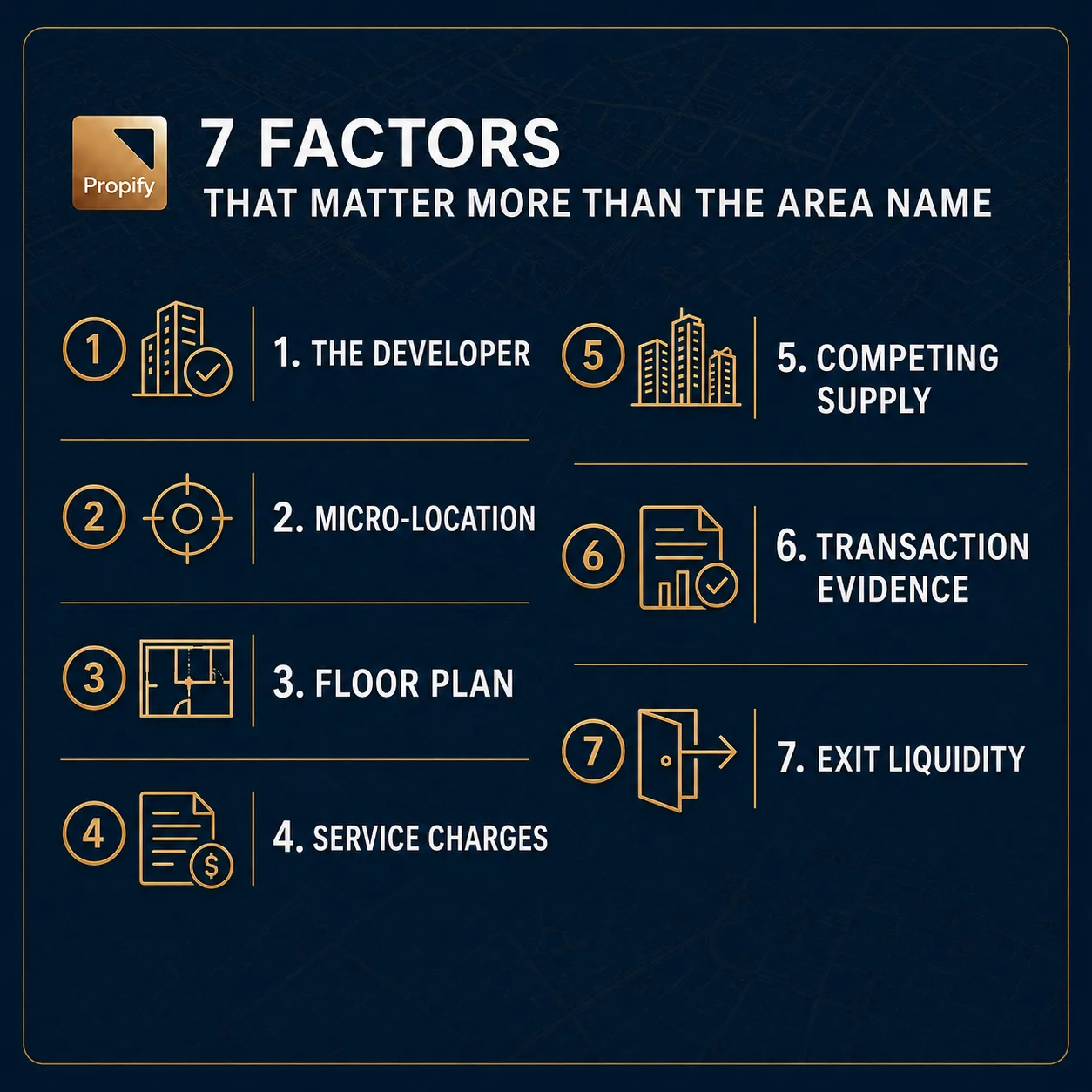
Seven Factors That Matter More Than the Area Name
Choosing the right community is only the first layer. Before buying, investors should examine the property itself.
1. The developer
Review delivery history, construction quality, after-sales service, community management and how earlier projects have performed after handover.
2. The exact micro-location
Ask what is within walking distance, how residents enter and leave the building, what will be built on neighbouring plots and whether the view is protected.
3. The floor plan
Tenants and end users pay for usable space. Long corridors, oversized balconies, awkward bedrooms and poor storage can reduce both rentability and resale appeal.
4. Service charges
High service charges can destroy net yield. Compare the charge per square foot and understand what facilities are being funded.
5. Competing supply
Identify how many similar units are completed, under construction and scheduled to hand over during the intended holding period.
6. Real transaction evidence
Asking prices are not transaction prices. Review registered sales, achieved rents and comparable units in the same building or immediate cluster.
7. Exit liquidity
Imagine the future buyer before purchasing. Is the unit affordable to a broad market? Is it suitable for an end user? Does it have a feature that another investor will value? A property can look profitable on paper but become difficult to sell if its buyer pool is too narrow.
The Risks Investors Should Not Ignore in 2026
Dubai’s long-term direction remains strong, but serious investment analysis must include the downside.
New supply
Dubai Land Department reported 937 projects under construction in 2025, a 25% annual increase. Supply is not evenly distributed. Some communities and unit types will absorb new homes easily; others may face rent and resale competition.
Paying too much for a payment plan
Flexible instalments are useful, but they can hide an inflated total price. The property’s market value at handover will depend on comparable homes, not the convenience of the original payment plan.
Unprotected views
An open view today can become a construction site tomorrow. Investors should examine the master plan and nearby plots rather than relying on the view from a sales-centre model.
High operating costs
Luxury facilities, cooling arrangements, hotel-style services and complex building systems can increase annual ownership costs.
Short-term-rental assumptions
Holiday-home income can look attractive during peak season, but annual performance depends on occupancy, nightly rate, furnishing, management, platform fees, cleaning and regulation. It should be modelled conservatively.
Market-cycle risk
Dubai is a dynamic international market. Prices can be affected by global liquidity, interest rates, regional events, currency movements and the timing of new supply. Investors using short holding periods or high leverage have less room for error.
Our View: The Best Dubai Investment Area Is the One That Matches the Buyer
If we were building a shortlist for different investors in 2026, it would look like this:
-
For dependable apartment demand: JVC, Business Bay, Dubai Marina and Al Furjan.
-
For high gross-yield potential: Discovery Gardens, selected JVC buildings, Arjan and affordable established communities.
-
For family-led long-term demand: Dubai Hills Estate, Arabian Ranches and selected Al Furjan properties.
-
For long-term infrastructure growth: Dubai Creek Harbour, Dubai South and Dubai Silicon Oasis.
-
For prime and ultra-prime capital: Downtown Dubai, Palm Jumeirah and truly scarce waterfront property.
-
For investors who may live in the property later: Dubai Hills Estate, Dubai Creek Harbour, Dubai Marina and mature family communities.
But we would never recommend an area without first checking the exact property.
In Dubai, two apartments in the same community can produce completely different results. One may have a protected view, efficient layout, low service charges and strong tenant demand. The other may be overpriced, difficult to access and surrounded by competing supply. The community creates the opportunity. The individual deal determines the return.
Frequently Asked Questions
What is the best area to invest in Dubai?
There is no single best area for every investor. JVC and Al Furjan can suit income-focused buyers, Business Bay and Dubai Marina offer strong liquidity, Dubai Hills Estate attracts long-term family demand, while Dubai Creek Harbour and Dubai South offer infrastructure-led growth potential.
Which area in Dubai offers the highest rental yield?
Affordable and mid-market communities often produce higher gross yields than prime areas because the purchase price is lower relative to rent. Recent market reporting has identified Discovery Gardens, Al Furjan and other value communities among Dubai’s stronger projected-yield locations. Actual net yield depends on the purchase price, service charges, vacancy and management costs.
Is JVC a good area for property investment?
JVC can be a good investment because it has broad tenant demand and relatively accessible prices. However, it also has substantial new supply. Investors should choose a reputable building, efficient layout, good micro-location and competitive price rather than buying based on the community name alone.
Is Dubai South a good long-term investment?
Dubai South has a strong long-term case because of Expo City, aviation, logistics and the expansion of Al Maktoum International Airport. It is generally better suited to patient investors who can hold through the area’s development rather than buyers expecting immediate central-Dubai rents.
Is Dubai Creek Harbour a good investment?
Dubai Creek Harbour offers waterfront living, Emaar master planning and future Metro Blue Line connectivity. It may suit buyers seeking long-term capital growth, although handover supply, tower position, view protection and the time required for the wider community to mature should be considered.
Is it better to invest in Downtown Dubai or Business Bay?
Downtown Dubai is stronger for global recognition, prime positioning and scarce landmark views. Business Bay usually offers a wider range of prices and buildings and may provide a better balance of yield and central-city liquidity. The right choice depends on budget, unit quality and investment objective.
Should I buy an apartment or villa in Dubai?
Apartments generally have lower entry prices, broader tenant pools and potentially higher gross yields. Villas can benefit from long-term family demand, land scarcity and stronger end-user appeal. The best choice depends on budget, holding period, maintenance tolerance and whether the priority is income or capital preservation.
What is a good rental yield in Dubai?
A good yield cannot be judged by one citywide percentage. The investor should compare the net return with properties of similar type, age, location and risk. Gross figures may look impressive, but service charges, maintenance, vacancy and management expenses determine the real income.
Can foreigners buy property in Dubai?
Foreign nationals can buy freehold property in designated areas of Dubai. Before purchasing, buyers should verify the property’s ownership designation, developer and project registration, contract terms, payment schedule and all transaction costs.
How much money do I need to invest in Dubai property?
The required budget depends on the area and property type. Lower-priced studios and apartments are available in affordable communities, while prime apartments, townhouses and villas require significantly more capital. Buyers should budget for acquisition costs and maintain a reserve for service charges, furnishing, maintenance and vacancy.
Final Thoughts
Dubai remains one of the most varied property markets in the world. Within one city, an investor can buy a high-yield studio, a family townhouse, a waterfront apartment, a branded residence or a trophy villa.
That variety is an advantage, but it also creates noise. Every project is marketed as a landmark. Every area is described as the next major destination. Every payment plan is presented as an opportunity. Successful investors go one level deeper.
They start with a clear objective. They compare actual transactions rather than brochure prices. They calculate net income rather than headline yield. They study supply, infrastructure and the future tenant. Most importantly, they remain willing to reject a property when the numbers do not support the story.
The best area to invest in Dubai is not simply the one growing fastest today. It is the area where real demand, the individual property and the purchase price still make sense when the marketing is removed.
Planning to invest in Dubai property? Propify Real Estate can help you compare communities, developers and individual projects based on your budget, target return and holding period. Speak with our team for a personalised shortlist built around your investment strategy—not a generic list of available units.
Related insights
 Invest
Why Buyers from the UK, US, Canada and Australia Are Looking at Palm Jebel Ali
Palm Jebel Ali is quickly becoming one of the most discussed new waterfront developments in Dubai. Buyers from the United Kingdom, United States, Canada and Australia are looking beyond established communities such as Palm Jumeirah and exploring what Dubai’s next major coastal destination could offe
Read article Invest
Can Foreigners Buy Property in Dubai?
Can Foreigners Buy Property in Dubai? A Complete Guide to Buying Property in Dubai from Abroad
Read article Invest
How Much Money Do You Need to Invest in Dubai? Full Cost Guide 2026
Dubai property investment can begin with approximately $150,000 to $200,000 for an entry-level apartment purchased in cash.
Read article